Agent2Agent (A2A) Protocol Explained: The Complete Developer Guide for 2026
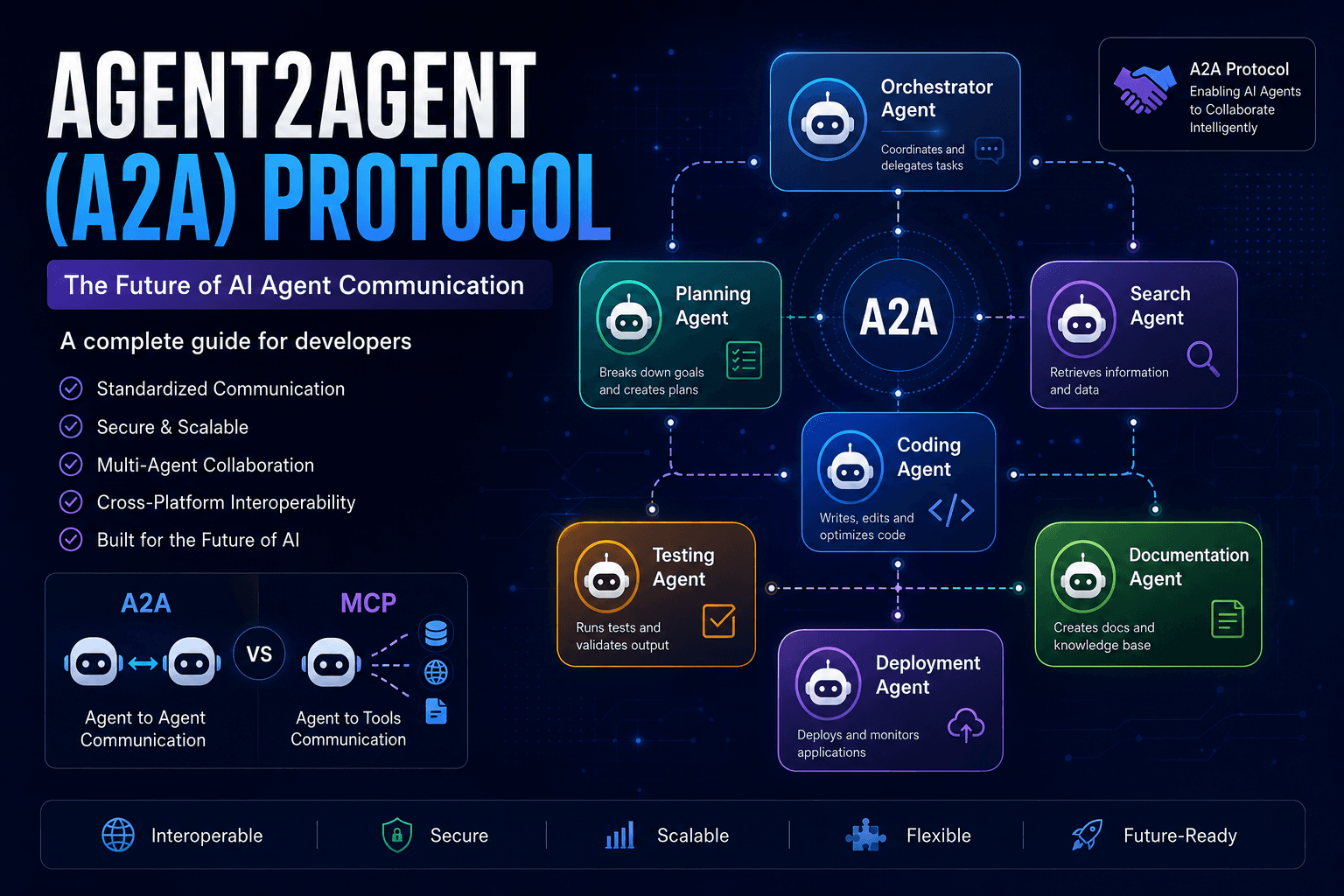
Discover how the Agent2Agent (A2A) Protocol enables AI agents to collaborate securely and efficiently. Learn its architecture, use cases, benefits, and how it compares with MCP.
Artificial Intelligence is rapidly evolving from single-chat assistants into collaborative AI systems.
Instead of one AI model handling every task, modern applications increasingly rely on multiple specialized AI agents working together.
Imagine an AI software engineer that writes code, another agent that reviews it, another that runs tests, and another that deploys the application.
For these agents to collaborate effectively, they need a common communication standard.
That's exactly why the Agent2Agent (A2A) Protocol was created.
A2A provides a standardized way for AI agents to discover each other, exchange information, delegate tasks, and collaborate across different platforms and providers.
In this guide, you'll learn what A2A is, how it works, why it matters, and how it compares to the Model Context Protocol (MCP).
What Is the Agent2Agent (A2A) Protocol?
The Agent2Agent Protocol, commonly called A2A, is an open communication protocol that enables AI agents to securely communicate and collaborate with one another.
Rather than building custom integrations between every AI application, A2A defines a shared language that allows independent agents to exchange tasks and results.
Think of A2A as a common protocol that lets AI systems work together, even if they were built by different companies or use different AI models.
Why Was A2A Created?
Modern AI applications are becoming increasingly complex.
One AI model is rarely responsible for every task.
Instead, organizations are building systems composed of multiple specialized agents.
For example:
- Research Agent
- Coding Agent
- Testing Agent
- Documentation Agent
- Deployment Agent
Without a standard communication protocol, connecting these agents becomes difficult.
Developers would need to build custom integrations between every agent.
As the number of agents grows, maintaining these integrations becomes expensive and difficult to scale.
A2A solves this problem by providing a universal communication layer.
How Does A2A Work?
A simplified workflow looks like this:
User

↓

Planning Agent

↓

Coding Agent

↓

Testing Agent

↓

Security Agent

↓

Deployment Agent

↓

User
Each agent specializes in a particular task.
Instead of one AI attempting to solve everything, multiple agents collaborate to complete the workflow.
This approach improves:
- Accuracy
- Reliability
- Maintainability
- Scalability
Core Components of A2A
Every Agent2Agent system typically includes several important components.
Agent Discovery
Before agents can collaborate, they need to discover available agents.
Examples:
- Documentation Agent
- Database Agent
- Search Agent
- Security Agent
Discovery enables dynamic collaboration instead of hardcoded integrations.
Task Delegation
One agent can assign work to another.
Example:
Planning Agent
↓
"Generate database schema."
↓
Database Agent
↓
Returns SQL schema
This delegation allows each agent to focus on its own expertise.
Communication
Agents exchange structured messages.
Instead of plain text conversations, A2A supports machine-readable communication.
Typical information includes:
- Tasks
- Status
- Context
- Results
- Errors
Authentication
Since AI agents may access sensitive systems, secure authentication is essential.
Authentication helps ensure:
- Trusted communication
- Secure access
- Identity verification
Result Sharing
After completing work, agents return structured responses.
Examples include:
- Generated code
- Documents
- Reports
- Analysis
- API responses
Why A2A Matters
As AI systems become larger, one intelligent assistant is no longer enough.
Businesses increasingly need specialized AI workers.
Examples include:
- Customer Support Agent
- Finance Agent
- HR Agent
- Sales Agent
- Engineering Agent
Instead of combining every capability into one enormous AI system, organizations can build smaller specialized agents that communicate through A2A.
Real-World Example
Imagine building an AI software company.
The workflow could look like this:
Customer Request

↓

Planning Agent

↓

Backend Agent

↓

Frontend Agent

↓

Testing Agent

↓

Documentation Agent

↓

Deployment Agent
Every agent focuses on one responsibility.
This modular architecture is easier to maintain than one giant AI assistant.
A2A vs MCP
Many developers confuse A2A with MCP.
Although both are AI standards, they solve different problems.
| Feature | A2A | MCP |
|---|---|---|
| Agent Communication | ✅ | ❌ |
| Tool Access | ❌ | ✅ |
| Multi-Agent Collaboration | ✅ | Limited |
| External APIs | Indirect | ✅ |
| File Systems | Via MCP | ✅ |
| Databases | Via MCP | ✅ |
The simplest way to remember the difference is:
A2A connects AI agents.
MCP connects AI agents to tools and data.
Rather than competing, these protocols complement each other.
Using A2A and MCP Together
Many production AI systems will use both standards.
Example:
User

↓

Planning Agent

↓

A2A

↓

Coding Agent

↓

MCP

↓

GitHub

↓

Database

↓

File System

↓

Cloud APIs
A2A coordinates communication between agents.
MCP gives those agents access to external tools and resources.
Together they create a powerful foundation for modern AI applications.
Benefits of A2A
Developers adopting the Agent2Agent Protocol gain several advantages.
Better Scalability
Applications can grow by adding specialized agents instead of expanding one massive AI system.
Improved Maintainability
Each agent focuses on one responsibility.
This makes systems easier to update and debug.
Vendor Flexibility
Different agents can use different AI providers.
For example:
- Claude for reasoning
- GPT for coding
- Gemini for search
A2A enables collaboration regardless of the underlying model.
Reusability
Specialized agents can be reused across multiple projects without major changes.
A2A Architecture
Most Agent2Agent implementations follow a modular architecture where each AI agent is responsible for a single capability.
A simplified architecture looks like this:
User
   │
   ▼
Orchestrator Agent
   │
   ├───────────────┐
   ▼               ▼
Planning Agent   Search Agent
   │               │
   ▼               ▼
Coding Agent    Documentation Agent
   │               │
   └──────┬────────┘
          ▼
     Testing Agent
          │
          ▼
 Deployment Agent
          │
          ▼
       Final Result
The orchestrator coordinates communication while specialized agents focus on individual tasks.
This modular approach makes AI applications easier to scale and maintain.
Real-World Use Cases
The Agent2Agent Protocol is suitable for many production environments.
AI Software Development
Multiple AI agents collaborate to:
- Plan features
- Write code
- Review pull requests
- Generate documentation
- Execute automated tests
Customer Support
One agent can:
- Understand customer intent
Another can:
- Search internal documentation
Another can:
- Escalate complex tickets
The customer experiences one conversation while several AI agents collaborate behind the scenes.
Enterprise Knowledge Management
Organizations often have information spread across:
- Databases
- PDFs
- Wikis
- APIs
- Cloud storage
Different agents specialize in retrieving information from each source before combining results into a single response.
Healthcare
Separate AI agents may handle:
- Patient history
- Lab reports
- Drug interactions
- Appointment scheduling
Keeping responsibilities separate improves maintainability and auditing.
Financial Services
Financial organizations may create agents for:
- Fraud detection
- Risk analysis
- Compliance
- Customer onboarding
- Reporting
Each agent specializes in one domain while collaborating through A2A.
Best Practices for Implementing A2A
Developers should follow several best practices when building multi-agent systems.
Give Every Agent One Responsibility
Avoid building "super agents."
Instead, create focused agents that solve one problem well.
For example:
- Search Agent
- Coding Agent
- QA Agent
- Reporting Agent
This approach improves maintainability and testing.
Minimize Communication
Too many agent interactions increase latency.
Only exchange the information required to complete the task.
Use Structured Messages
Avoid sending large blocks of free-form text.
Instead exchange structured data whenever possible.
Example:
{
  "task": "Generate API documentation",
  "priority": "High",
  "status": "Pending"
}
Structured communication reduces ambiguity.
Log Every Interaction
Production AI systems should log:
- Requests
- Responses
- Errors
- Execution time
Logging improves debugging and monitoring.
Secure Every Agent
Each AI agent should authenticate before communicating.
Use:
- OAuth
- API Keys
- JWT
- Role-based permissions
Never assume every agent is trusted automatically.
Common Mistakes
Many teams encounter similar problems when building multi-agent systems.
Creating Too Many Agents
Not every task requires its own agent.
Keep the architecture as simple as possible.
Overlapping Responsibilities
If two agents perform the same work, maintenance becomes difficult.
Define clear responsibilities for each agent.
Ignoring Failures
Agents should gracefully handle:
- Network issues
- API failures
- Invalid responses
- Timeouts
Robust error handling is essential.
Missing Observability
Without monitoring, it's difficult to understand:
- Which agent failed
- Why requests slowed down
- Where bottlenecks occur
Invest in proper logging and metrics.
Performance Optimization
Efficient multi-agent systems focus on minimizing unnecessary work.
Tips include:
- Cache repeated results
- Run independent agents in parallel
- Limit unnecessary context sharing
- Compress large payloads
- Reuse previous task results
- Monitor latency
- Optimize prompts
These optimizations improve both speed and cost.
Security Considerations
AI agents often interact with sensitive systems.
Protect your application by:
- Encrypting communication
- Validating agent identity
- Applying least-privilege access
- Auditing every action
- Rotating API keys regularly
- Monitoring unusual behavior
Security should be part of the architecture—not an afterthought.
A2A and the Future of AI Development
The software industry is moving toward collaborative AI systems.
Instead of relying on one general-purpose assistant, future applications will combine specialized AI agents working together.
We can expect:
- Better reasoning
- Improved scalability
- More reliable automation
- Easier maintenance
- Cross-platform interoperability
Protocols like A2A provide the foundation for this next generation of AI software.
Frequently Asked Questions
Is A2A the same as MCP?
No.
A2A enables communication between AI agents.
MCP enables AI agents to access external tools, APIs, databases, and file systems.
Many applications use both together.
Can A2A work with different AI models?
Yes.
One of its strengths is enabling collaboration between agents powered by different language models.
Does every AI application need A2A?
No.
Simple chatbots or single-agent applications may not require it.
A2A becomes valuable when multiple specialized agents need to collaborate.
Is A2A open?
The protocol is designed to encourage interoperability and collaboration across AI ecosystems, making it easier for different implementations to communicate.
Related Articles
Continue exploring modern AI development:
- Model Context Protocol (MCP) Explained
- How AI Agents Work
- AI SDK Complete Guide
- Build a RAG Chatbot with Next.js
- OpenAI API Complete Guide
- LangChain Tutorial for Beginners
- Prompt Engineering Complete Guide
- AI Hallucinations Explained
Final Thoughts
The Agent2Agent (A2A) Protocol represents an important step toward more capable and collaborative AI systems. As applications evolve beyond single assistants into networks of specialized agents, standardized communication becomes increasingly valuable.
When combined with technologies such as the Model Context Protocol (MCP), Retrieval-Augmented Generation (RAG), and modern AI SDKs, A2A enables developers to build intelligent applications that are modular, scalable, and easier to maintain.
While the ecosystem is still evolving, learning how AI agents communicate and collaborate today will help you design better software for the next generation of AI-powered applications.
Whether you're building developer tools, enterprise assistants, customer support platforms, or autonomous workflows, understanding A2A will give you a solid foundation for creating robust multi-agent systems.
Related Articles
More from the AI + Code category
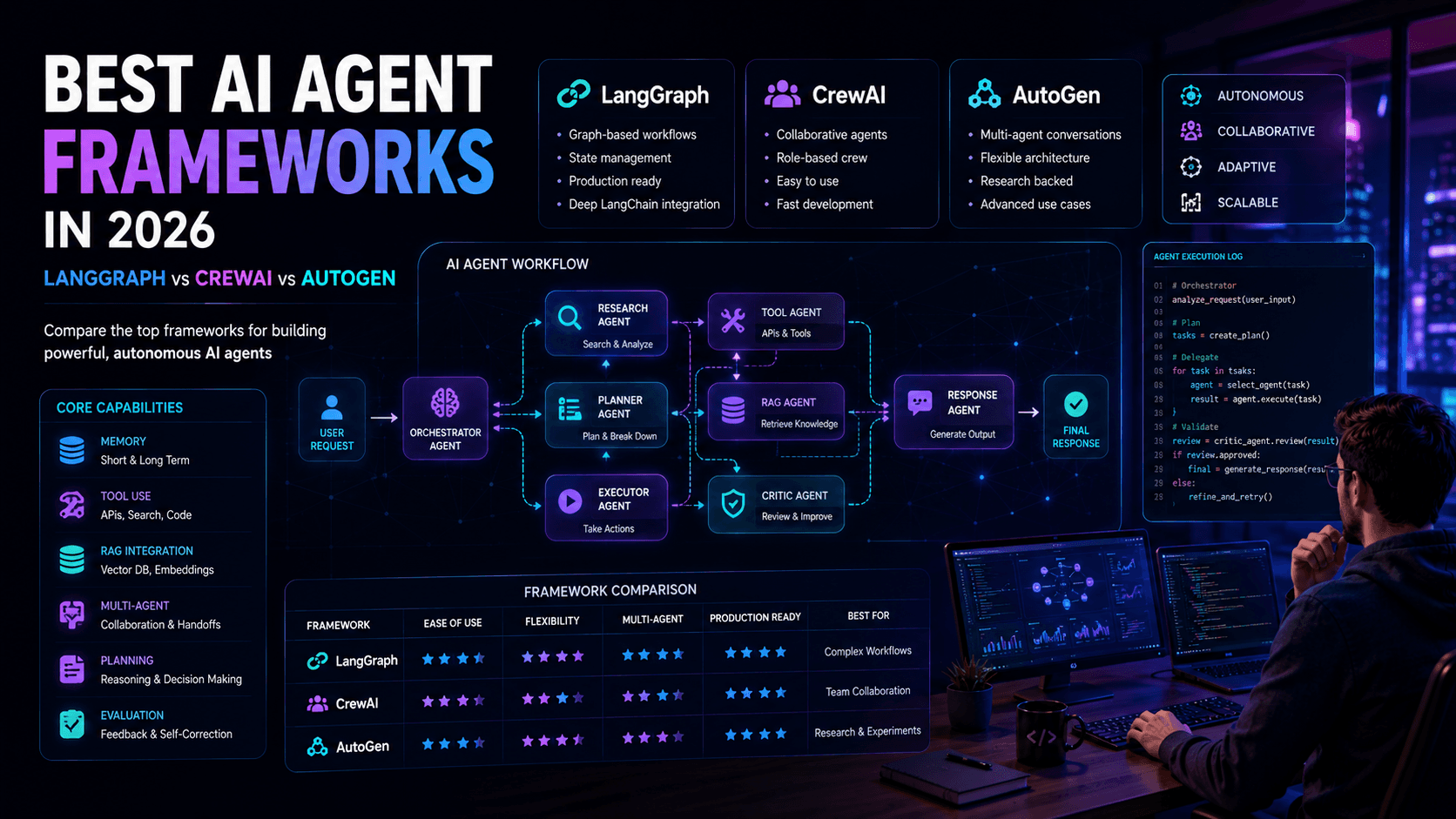
Best AI Agent Frameworks in 2026: LangGraph vs CrewAI vs AutoGen
Looking to build AI agents? This guide compares LangGraph, CrewAI, AutoGen, and other leading AI agent frameworks to help developers choose the right solution.
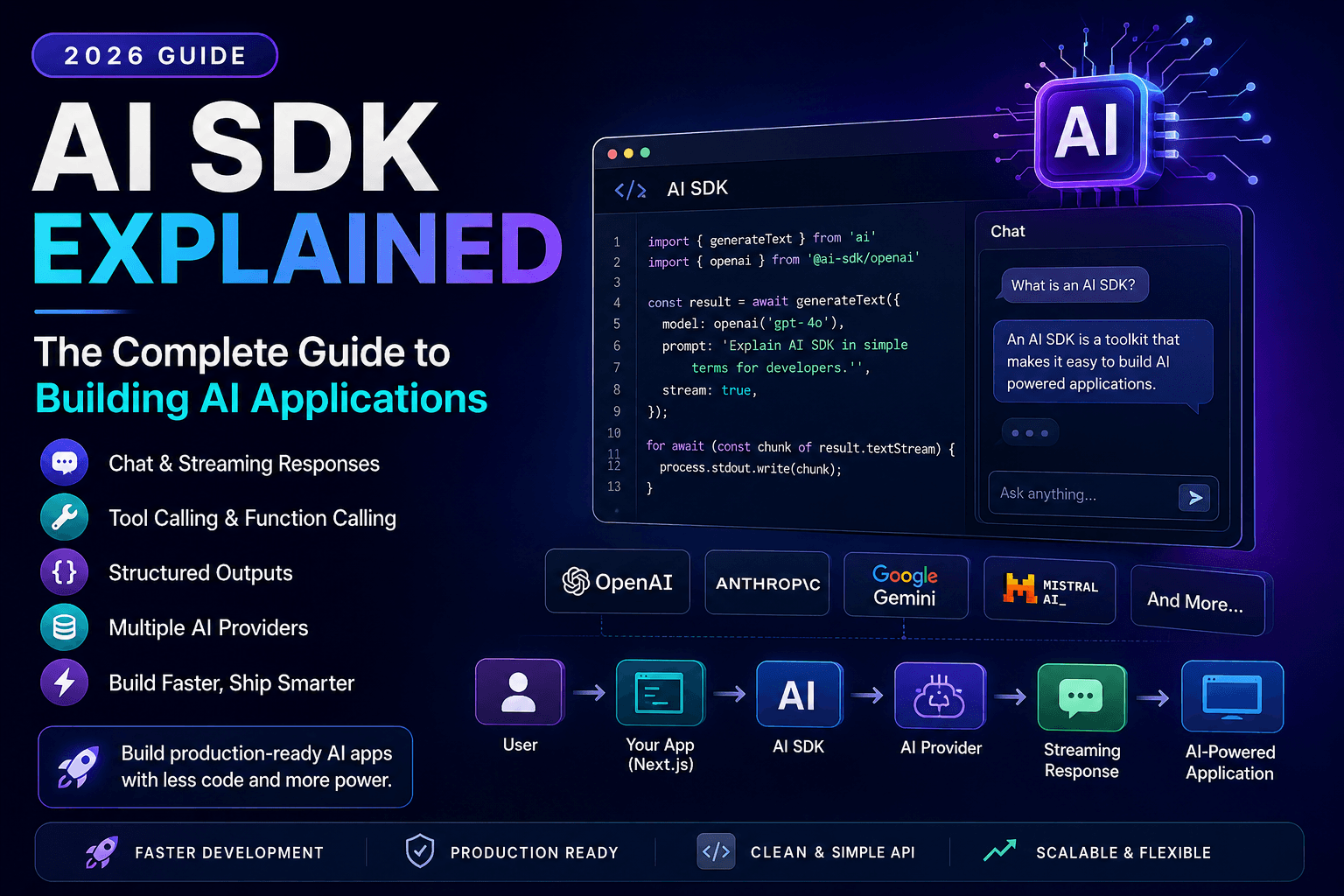
AI SDK Explained: The Complete Guide to Building AI Applications in 2026
Discover how AI SDKs simplify building AI-powered applications. Learn streaming responses, tool calling, chat interfaces, structured outputs, and production best practices.
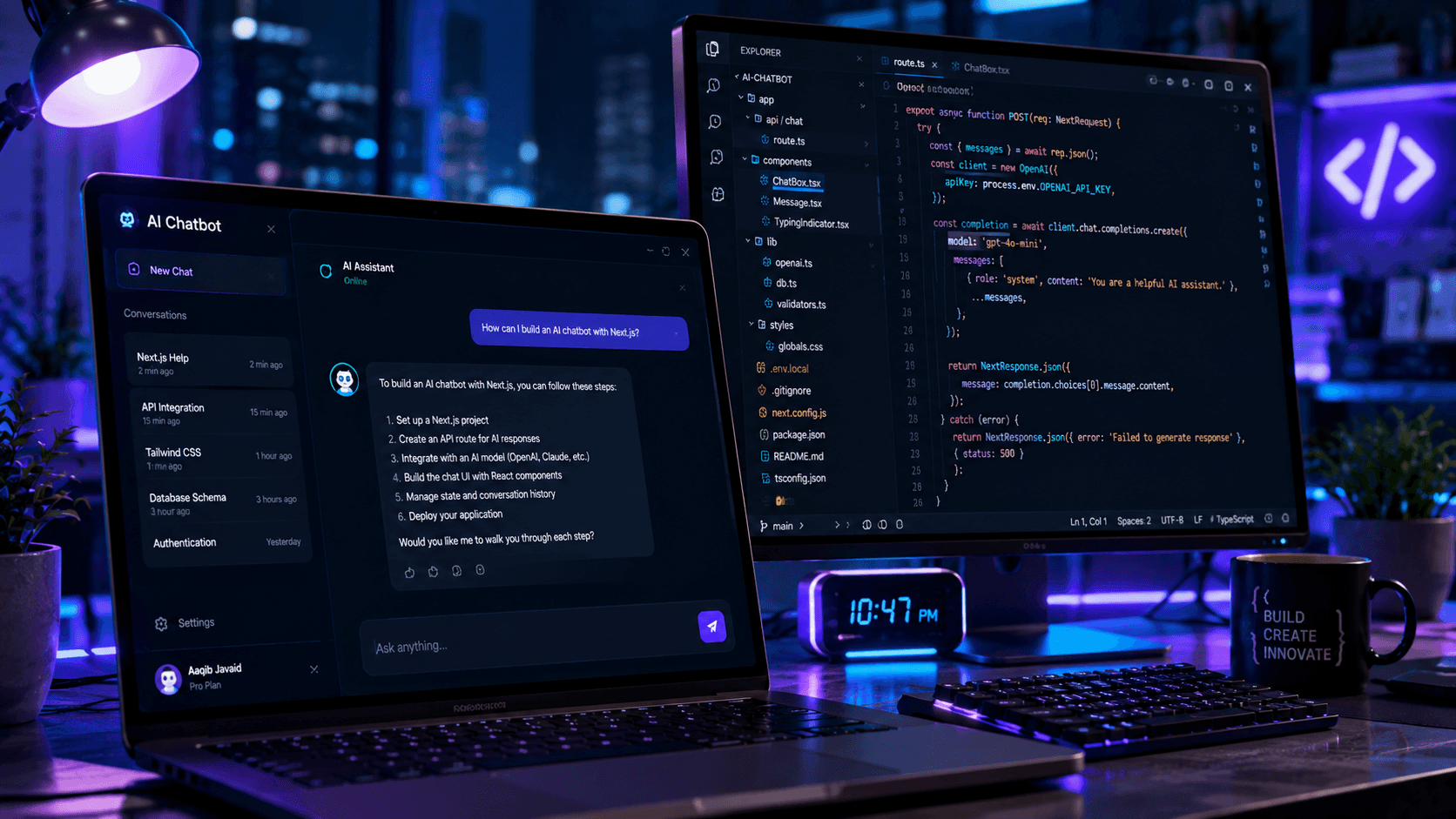
Build an AI Chatbot with Next.js: Complete Developer Guide
Want to build your own AI chatbot? This guide walks through creating an AI-powered chatbot with Next.js, React, and modern AI APIs.