Data Structures and Algorithms for Beginners: Complete Guide in 2026

Master the fundamentals of Data Structures and Algorithms with this beginner-friendly guide. Learn the concepts every software developer should know.
If you've ever searched for software engineering interview preparation, you've probably heard the term:
DSA (Data Structures and Algorithms).
For many beginners, these concepts seem intimidating.
The good news is that Data Structures and Algorithms are simply tools that help developers solve problems more efficiently.
Whether you're building websites, APIs, mobile apps, or enterprise software, understanding DSA will make you a better programmer.
In this guide, you'll learn what Data Structures and Algorithms are, why they matter, and which concepts every developer should know.
What Are Data Structures?
A data structure is a way of organizing and storing data.
Think of it as a container that helps manage information efficiently.
Different data structures are designed for different purposes.
Examples include:
- Arrays
- Linked Lists
- Stacks
- Queues
- Trees
- Graphs
- Hash Tables
Choosing the right data structure can dramatically improve application performance.
What Are Algorithms?
An algorithm is a set of instructions used to solve a problem.
Examples:
- Sorting data
- Searching for information
- Finding the shortest path
- Processing user input
Every software application relies on algorithms behind the scenes.
Why Should Developers Learn DSA?
Many developers ask:
“"Do I really need DSA if I build websites?"
The answer is yes.
DSA helps you:
- Write efficient code
- Improve problem-solving skills
- Pass technical interviews
- Understand software performance
- Build scalable applications
Even modern frameworks like React and Next.js rely heavily on efficient algorithms internally.
Understanding Time Complexity
One of the most important DSA concepts is:
Time Complexity
It measures how efficiently an algorithm performs as data grows.
Common examples:
O(1)   Constant Time
O(log n) Logarithmic Time
O(n)   Linear Time
O(n²)  Quadratic Time
Generally:
O(1) > O(log n) > O(n) > O(n²)
The more efficient the algorithm, the better the performance.
Arrays
Arrays are one of the most common data structures.
Example:
const fruits = ["Apple", "Banana", "Orange"];
Arrays allow you to store multiple values in a single variable.
Advantages
- Fast access by index
- Easy to use
- Supported in every programming language
Use Cases
- Lists
- Tables
- Collections
Linked Lists
Linked Lists store data as connected nodes.
Unlike arrays, elements don't need to be stored together in memory.
Advantages
- Dynamic size
- Efficient insertions
Use Cases
- Memory management
- Browser history
- Navigation systems
Stacks
A stack follows:
Last In, First Out (LIFO)
Example:
Push
Push
Push
Pop
The last item added is removed first.
Real-World Examples
- Undo functionality
- Browser navigation
- Function calls
Queues
A queue follows:
First In, First Out (FIFO)
Example:
Person 1
Person 2
Person 3
The first person enters first and leaves first.
Real-World Examples
- Task scheduling
- Print queues
- Customer support systems
Trees
Trees organize data hierarchically.
Example:
Root
├── Child A
├── Child B
└── Child C
Real-World Examples
- File systems
- Categories
- Menus
Trees are widely used in databases and search systems.
Hash Tables
Hash Tables provide extremely fast lookups.
Example:
const user = {
  name: "John",
  role: "Developer"
};
Advantages
- Fast searching
- Efficient storage
Real-World Examples
- Authentication systems
- Caching
- Databases
Common Algorithms
Searching Algorithms
Finding specific information in a dataset.
Examples:
- Linear Search
- Binary Search
Sorting Algorithms
Organizing data into a specific order.
Examples:
- Bubble Sort
- Merge Sort
- Quick Sort
Traversal Algorithms
Used to navigate trees and graphs.
Examples:
- Depth First Search (DFS)
- Breadth First Search (BFS)
DSA and Technical Interviews
Many companies assess DSA knowledge during interviews.
Typical questions involve:
- Arrays
- Strings
- Trees
- Hash Maps
- Sorting
- Searching
Strong DSA skills often improve interview performance significantly.
Do Frontend Developers Need DSA?
Absolutely.
While frontend developers may not use advanced algorithms daily, understanding DSA helps with:
- Performance optimization
- Problem solving
- Technical interviews
- Complex application logic
Best Way to Learn DSA
Follow this sequence:
Arrays
↓
Strings
↓
Linked Lists
↓
Stacks
↓
Queues
↓
Hash Tables
↓
Trees
↓
Graphs
↓
Algorithms
Avoid jumping directly into advanced topics.
Master the fundamentals first.
Common Beginner Mistakes
Memorizing Without Understanding
Focus on understanding concepts instead of memorizing solutions.
Ignoring Complexity
Always consider time and space complexity.
Skipping Practice
DSA requires consistent practice.
Learning theory alone is not enough.
Recommended Resources
Combine DSA learning with strong programming fundamentals.
Read:
- How to Become a Software Developer in 2026
- Node.js for Beginners
- Git and GitHub for Beginners
- JavaScript vs TypeScript
- Software Engineer vs Web Developer
These skills complement Data Structures and Algorithms perfectly.
Frequently Asked Questions
Is DSA Difficult?
Not when learned gradually.
Most developers struggle because they try to learn advanced topics too quickly.
How Long Does It Take to Learn DSA?
Most beginners can understand the fundamentals within a few months of consistent practice.
Is DSA Required for Web Development?
While not always required for daily tasks, DSA improves coding ability and interview performance.
Should Beginners Learn DSA First?
Learn programming basics first, then start learning DSA.
Final Thoughts
Data Structures and Algorithms are foundational skills for every software developer.
They teach you how to think critically, solve problems efficiently, and build better software.
Whether your goal is becoming a frontend developer, backend engineer, full-stack developer, or software engineer, mastering DSA will strengthen your technical skills and open new career opportunities.
Start with the basics, practice consistently, and focus on understanding concepts rather than memorizing solutions. The investment will pay off throughout your development career.
Related Articles
More from the Programming category

React useState Hook Complete Guide (2026): Syntax, Examples & Best Practices
Learn everything about React's useState Hook, including syntax, real-world examples, updating state correctly, best practices, and common mistakes.
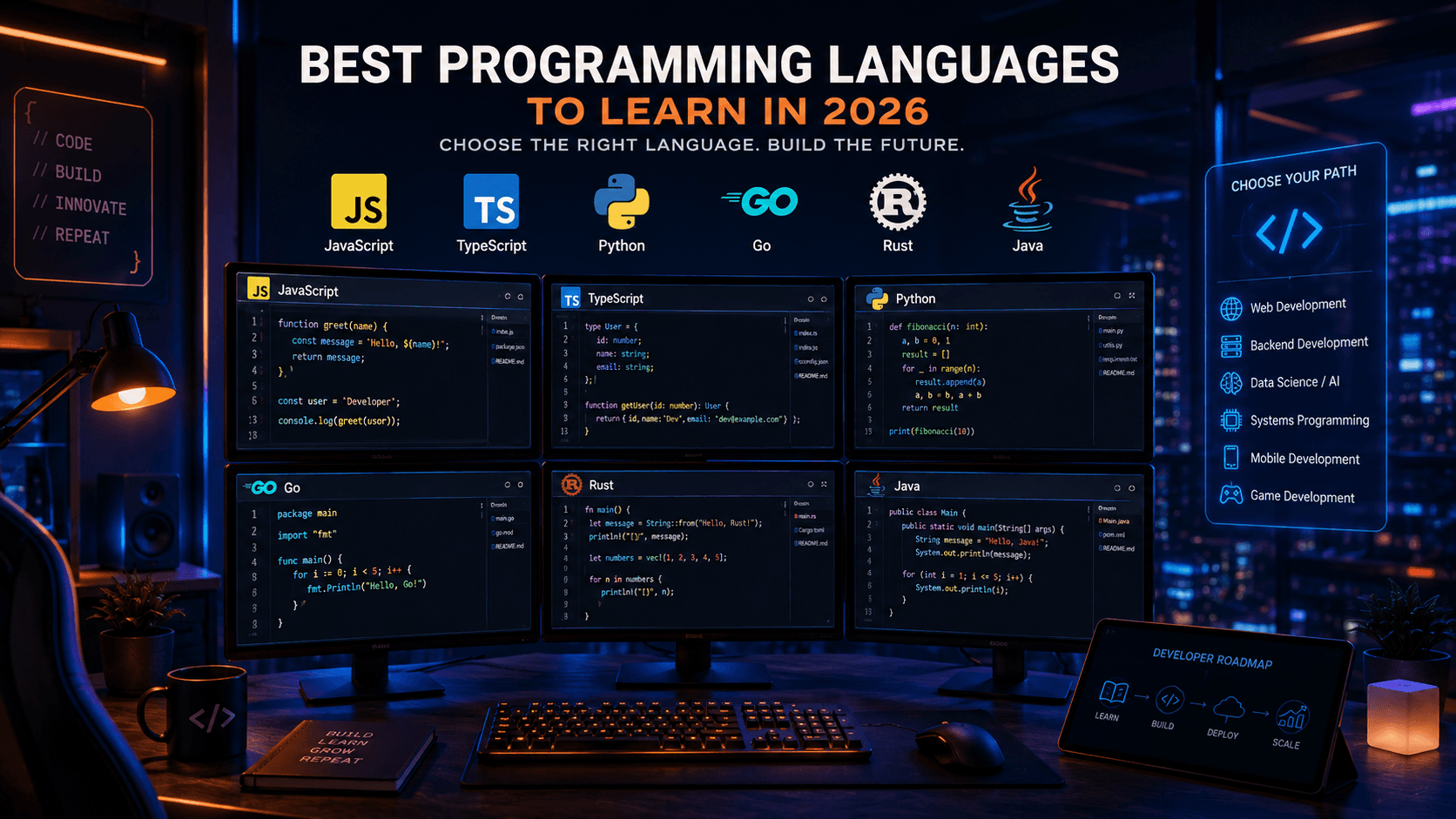
Best Programming Languages to Learn in 2026: Complete Developer Guide
Not sure which programming language to learn in 2026? This guide compares the most in-demand programming languages and helps developers choose the right path.

Frontend Developer Roadmap 2026: Complete Guide for Beginners
Want to become a frontend developer in 2026? This step-by-step roadmap covers the technologies, tools, projects, and skills employers are looking for today.